How to Tell a Marsh Harrier from a Buzzard and Red Kite
How to Tell a Marsh Harrier from a Buzzard and Red Kite
A large raptor is hanging over the motorway, or quartering the far side of a reedbed. Is it a marsh harrier, a common buzzard or a red kite? All three can turn up over the same stretch of countryside, and from a distance they can blur into one brown bird. The good news is that shape, movement, place and time of year usually give the answer before you see any plumage detail. Start with the outline, then watch how the bird uses the air.
Start with the silhouette
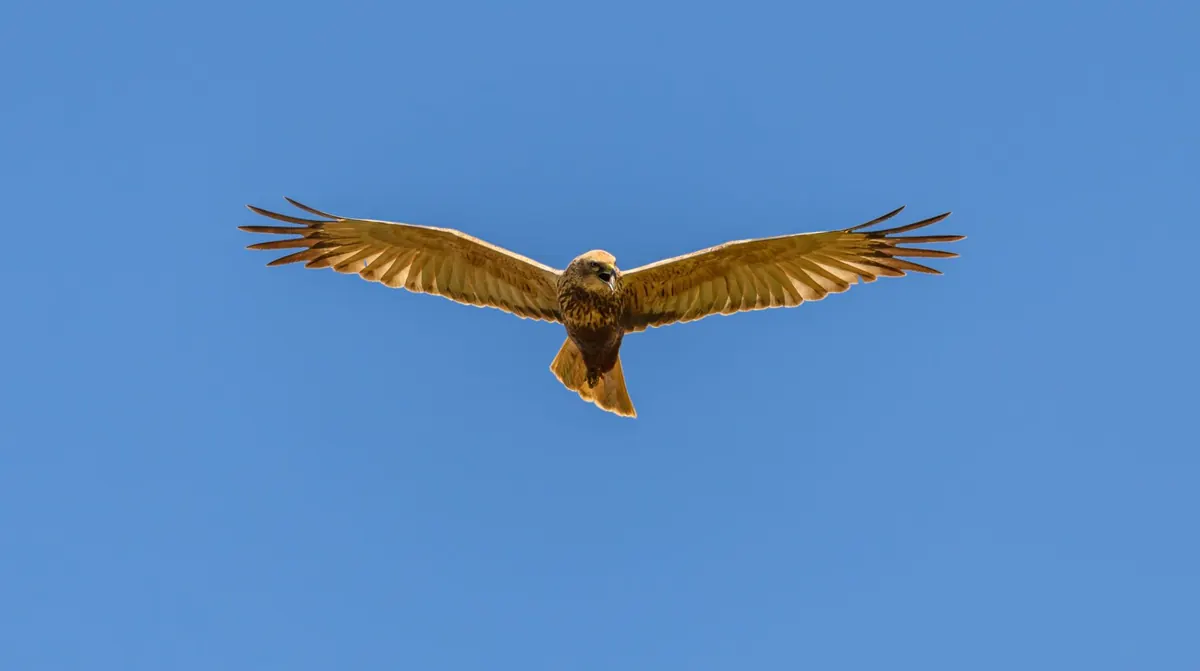
When a bird is gliding or soaring, the outline is your best clue. Look at the wings first, then the tail. A marsh harrier has long, broad wings and a long tail. It often holds its wings in a shallow V, with the tips slightly drooped or raised, and the body looks slim and stretched out. The head is small, and the neck can look a little long when the bird is scanning below.
A common buzzard looks more compact. Its wings are broad and rounded, and its tail is shorter. In a soar, it often holds its wings in a shallow V too, but the whole bird seems chunkier, with a fuller body and a wider, fan-shaped tail. A red kite is also large, but its wings are longer and more angled. The tail is the giveaway: deeply forked when spread, and still noticeably long and flexible when closed. From below, the pale head and white underwing patches stand out on many birds.
- Marsh harrier: long wings, long tail, slim body, shallow V.
- Common buzzard: broad rounded wings, short fan tail, compact body.
- Red kite: long wings, deeply forked tail, pale head, white underwing patches.
Tail shape is the quickest single check. A fork points to red kite. A short, broad fan points to buzzard. A long, straight-edged tail with a rounded tip points to marsh harrier. If the tail is closed, look at its length relative to the wings: a marsh harrier’s tail extends well beyond the wingtips when gliding, while a buzzard’s tail looks stubby and a red kite’s tail still looks long and often twists or angles as the bird steers.
Watch the flight style
Behaviour separates them as much as shape. A marsh harrier is a low, slow hunter. It quarters back and forth over reedbeds, wet grassland and marshy fields, usually only a few metres above the vegetation. Its wings are held in a shallow V, and it often rocks or tilts from side to side as it scans the ground. It can look almost gull-like from a distance: buoyant, relaxed and unhurried, with deep, flexible wingbeats.
A common buzzard is more likely to be seen soaring on thermals or perched on a fence post, a telegraph pole or a bare branch. In the air it uses slow, powerful flaps followed by glides. When it hunts, it may hover briefly or drop onto prey, but it does not usually spend long periods quartering low over a reedbed in the manner of a harrier. On windy days, buzzards often hang almost motionless into the wind, wings bowed and tail fanned.
A red kite has a lazier, more elastic flight. It soars for long periods, often with a slight dihedral, and its long wings bend and twist as it adjusts to the air. It frequently looks as if it is steering with its tail, which twists from side to side. Kites also spend more time over woodland edges, farmland, villages and even roads, where they scavenge and hunt. They are social in winter, and several may gather at a roost or over a field being ploughed.
Use habitat and location as a filter
Place is not everything, but it narrows the odds. Marsh harriers are birds of wetlands. If the bird is over a large reedbed, a coastal marsh, a flooded gravel pit or a wet meadow, a harrier is a strong possibility. They also migrate and disperse, so in spring and autumn they can appear over unexpected fields, but the core habitat remains wet and low.
Common buzzards are the default raptor of mixed farmland, woodland edges, moorland fringes and hedgerow country. They are often seen perched or soaring over fields, and their mewing call is a common sound. Red kites are more associated with rolling countryside, wooded valleys, farmland and increasingly suburbs and motorway corridors. They are scavengers as much as hunters, so they are often seen drifting over roads, villages and fields where livestock are grazed.
If you are standing at a wetland reserve and a large brown raptor is low over the reeds, think marsh harrier first. If you are on a country lane and a broad-winged bird is soaring over a copse, think buzzard. If a long-winged bird with a forked tail is hanging over a motorway verge, think red kite.
Plumage clues, from below and above
Plumage is useful once the bird is close enough, but it should confirm what shape and behaviour already suggest. Adult male marsh harriers are striking: grey wings, black wingtips and a pale, almost creamy body. Females and young birds are brown, often with a pale crown and throat, and can look very dark. From below, a marsh harrier often shows pale flight feathers and a contrasting dark body, but the exact pattern varies with age and sex.
Common buzzards are variable. Most are brown with a pale breast band, dark wingtips and barred underparts. Some are very pale, almost white, and others are dark chocolate. From below, the wings often show a pale inner panel and dark trailing edge. The tail is usually barred, but the shape remains the most reliable feature.
Red kites are usually unmistakable once seen well. Adults have a rusty-red body, pale grey head, white underwing patches and a deeply forked tail. Young birds are duller and can look more brown, but the fork and the long, angled wings remain. From above, the pale head and white patches on the shoulders are often visible.
Time of year and weather
Season changes what you are likely to see. In winter, marsh harriers gather at communal roosts in reedbeds, sometimes in small groups. They can be seen arriving at dusk or leaving at dawn, flying low and deliberately. Buzzards are present all year, and on cold, clear mornings they often perch in trees or on posts before the first thermals form. Red kites also roost communally in winter, sometimes in woods near farmland, and can be seen in loose groups.
In spring and autumn, migration can put any of the three over almost any landscape. A marsh harrier over a dry ridge or a red kite over a coastal headland is possible. Weather matters too. Strong winds push birds to use different flight styles: harriers may struggle low over cover, while buzzards and kites can hang and glide. In poor light, shape and movement become even more important than colour.
A step-by-step identification routine
- Check the tail first. Forked and long means red kite. Short and fan-shaped means buzzard. Long and straight with a rounded tip means marsh harrier.
- Look at the wings. Long, broad and flexible suggests harrier or kite. Broad, rounded and compact suggests buzzard.
- Watch the flight. Low, slow quartering over reeds is classic marsh harrier. Soaring on thermals or perching is classic buzzard. Elastic soaring with tail twisting is classic red kite.
- Use habitat. Wetland and reedbed point to marsh harrier. Farmland and woodland edge point to buzzard. Rolling countryside, roads and villages point to red kite.
- Confirm with plumage. Only after the shape and behaviour fit, check the pale head and white underwing patches of red kite, the grey and black wingtips of a male marsh harrier, or the pale breast band of a buzzard.
Common confusions and how to avoid them
Distance and lighting cause most mistakes. A buzzard seen head-on can look long-winged and harrier-like, especially if it is gliding with its wings slightly raised. A marsh harrier in a strong glide can look compact, and a female or young bird can be as brown as a buzzard. Red kites can look surprisingly buzzard-like when the tail is closed or when they are flying directly away, because the fork is hidden.
Do not rely on a single feature. A pale head is a strong clue for red kite, but marsh harriers can also show a pale crown. A shallow V is common to buzzard and marsh harrier, so it cannot separate them on its own. A forked tail is conclusive for red kite, but it is only visible when the tail is spread. The safest approach is to combine tail shape, wing shape, flight behaviour and habitat, and to watch the bird for as long as possible.
Field tip: If you only have a few seconds, look for the tail. The fork of a red kite and the short fan of a buzzard are usually visible even in a brief view. If the tail looks long, straight and rounded, start thinking marsh harrier.
With practice, these three raptors stop being a brown blur. A marsh harrier will usually reveal itself by its low, buoyant quartering over wet ground. A common buzzard will sit on a post or soar in a compact, broad-winged silhouette. A red kite will show long, angled wings and that unmistakable forked tail. The more you watch, the more the landscape itself will tell you what to expect before the bird even appears.
Photo: Petr Ganaj / Pexels