How to Identify Common UK Herons and Egrets by Shape and Flight
Three tall, long-legged birds account for most heron-shaped sightings in Britain, and two of them are white. Learn their outlines and you can name a distant bird on a marsh, a shape crossing a reservoir or a figure standing in a wet field without ever seeing a feather detail. The trick is to read shape, flight and setting rather than plumage.
Start With Two Questions
Before anything else, ask whether the bird is grey or white. Grey with a yellow dagger of a bill means grey heron, and you can stop there. Everything below applies to the white birds.
Second, look at the neck. Herons and egrets fly with the neck folded back into a tight S, head tucked close to the shoulders. Spoonbills, cranes, geese and cormorants fly with the neck stretched out in front. A long white bird with its head on an outstretched neck is very unlikely to be an egret.
The Grey Heron: Hunched, Heavy and Grey
At about a metre tall, the grey heron is the largest of the three and the one you will meet most often. Standing, it looks thick-set and slightly stooped, with a soft S bend in the neck and the head held forward. The bill is long, straight and yellow; the head is white with a black stripe running back from the eye into a trailing plume. Adults are grey across the folded wings, with darker flight feathers. Young birds in their first autumn look duller and scruffier and lack the plumes, but the outline gives them away every time.
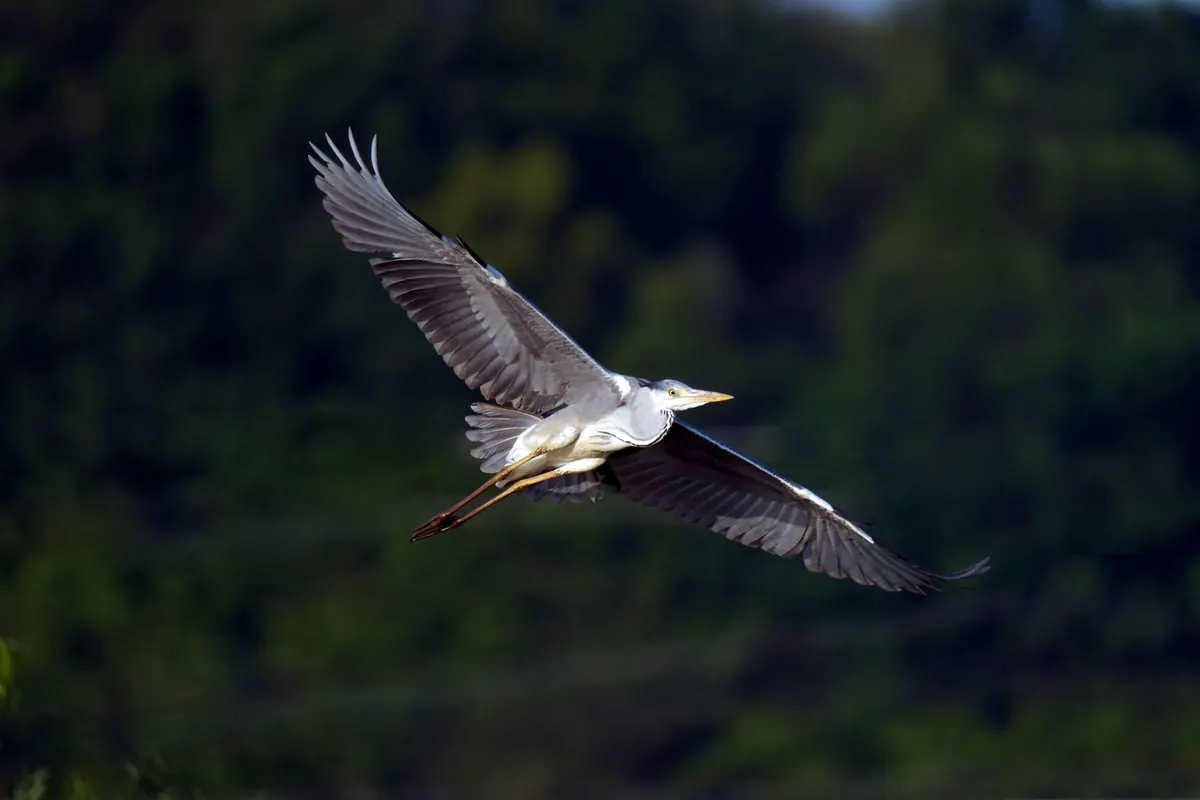
In flight a grey heron is unmistakable once you know what to look for: broad, rounded wings, slow deliberate beats, and the neck folded so tightly that the bird appears front-heavy, almost headless from some angles. The legs trail straight out behind the tail as two thin sticks. Watch for the rhythm — a few deep flaps, then a short glide. That unhurried glide-and-flap pattern is typical of a big heron going somewhere.
The Little Egret: Small, Black-Billed, Yellow-Shoed
The little egret is all white, but it is a compact bird — not much bigger than a mallard, and noticeably slighter than a grey heron. The bill is black. The legs are black with startling yellow feet, the feature that earned it the old nickname of the bird with golden slippers. In spring, adults grow two long, fine plumes from the nape that flutter in the breeze, and the bare skin between bill and eye can flush pinkish-red briefly at the height of the season.
Its flight is the giveaway at range. Wingbeats are quicker and shallower than a grey heron's, and the bird looks nimble rather than laboured. The neck is folded, but the whole silhouette reads narrower and more elegant, with the feet barely reaching past the tail. Little egrets often feed busily, running in shallow water, shuffling their feet to stir up prey, then stabbing sharply. A white heron-shaped bird that will not stand still is usually this one.
The Great White Egret: Big, Yellow-Billed, Long-Necked
This is the one that catches people out, because it is roughly the size of a grey heron and all white. Two features separate it from the little egret at a glance. First, the bill is yellow, not black. Second, it is a genuinely large bird; if you have a grey heron nearby for scale and the white bird matches it, you are looking at a great white egret.
On the ground the neck is long and often held with a distinct kink, giving a lankier, more upright look than the little egret's compact stance. The legs are black all the way down, including the feet. At close range, check the gape line: on a great white egret the yellow corner of the mouth extends back behind the eye, whereas on a little egret it stops around the eye. That is a useful confirming detail, not a starting point.
Five Checks in the Field
- Size: little egret is compact, not much larger than a mallard; grey heron and great white egret are both about a metre tall.
- Bill colour: yellow on grey heron and great white egret, black on little egret.
- Feet: yellow on a little egret, black on a great white egret, yellowish-brown on a grey heron.
- Neck in flight: folded into a tight S on all three, so a neck stretched out front rules out egret and heron entirely.
- Legs in flight: trailing sticks behind the tail on all three, with the great white egret's projecting furthest.
Flight Style: What the Wings and Feet Tell You
Wingbeat rhythm is the fastest way to make a call on a bird you have only a few seconds to watch. The grey heron and the great white egret both fly on slow, deep, powerful beats with long glides between them, and both look broad-winged and slightly lumbering. The little egret is quicker and shallower, more like a large gull in its urgency, and often travels in loose parties rather than alone.
Height matters too. Little egrets frequently fly low over water or along a shoreline, just above the surface. Grey herons often cross high, heading between feeding sites and a heronry or roost, and great white egrets do the same on longer, straighter flights across a wetland complex.
If a white bird is heading towards you and you cannot make out the bill, watch the feet: bright yellow feet against dark legs means little egret, and black feet on a big bird means great white.
Two other white birds cause confusion in Britain. The spoonbill is white with a long, flattened bill and flies with its neck outstretched, so it fails the neck test immediately. The cattle egret is smaller and stockier than a little egret, with a yellow bill, a short thick neck and a habit of feeding around livestock; it usually flies with the neck folded but in small flocks and with a hunched, compact look.
Habitat and Season: Where and When You Will Meet Them
Grey herons are genuinely everywhere, in every month: rivers, canals, ponds, ditches, estuaries, wet meadows, golf courses and garden ponds. They nest early, often in treetop colonies, and birds you see standing in a field in February are probably doing exactly what you think they are.
Little egrets are traditionally birds of the coast — estuaries, saltmarsh, muddy creeks and brackish lagoons — which is where they first spread to Britain from the continent, with the first nesting here in the 1990s. They are now increasingly found inland on lakes, rivers and flooded fields, and numbers swell in late summer and autumn as young birds disperse. In winter they tend to pull back towards the milder coast.
Great white egrets are the scarcest of the three, though they have become far more regular and have bred here in recent years. Your best chance is a large, shallow wetland with plenty of open water and reedbeds: gravel pits, reservoirs, flooded grassland and nature reserves. They are mostly an autumn and winter bird in Britain, with records building from October and peaking in the coldest months. In summer, most sightings are of wandering non-breeding birds.
Putting It Into Practice
Pick one local wetland and visit it once a fortnight for a couple of months. Note the date, the weather, how many heron-shaped birds you see and which ones they were. Patterns will emerge faster than you expect: herons every visit, little egrets mostly on the coast or in autumn, great white egrets turning up on the biggest, most open water.
A few habits sharpen the eye. Keep binoculars to hand rather than in the bag, and scan the far shoreline before you scan the near one — distant birds are the ones that need identifying. Use known birds for scale whenever you can: a mallard near a white egret, or a grey heron in the next field. Carry a notebook for bill colour and feet, because those two details are easy to convince yourself about later.
Above all, be honest when you cannot tell. A distant white bird behind reeds, seen for three seconds against a bright sky, is legitimately an unidentified egret, and recording it as one is better fieldcraft than guessing. With practice, the silhouette and the wingbeat will do the work for you, and you will know what you are looking at before the bird has finished crossing the estuary.
Photo: 대정 김 / Pexels